A town on the wrong side of a border
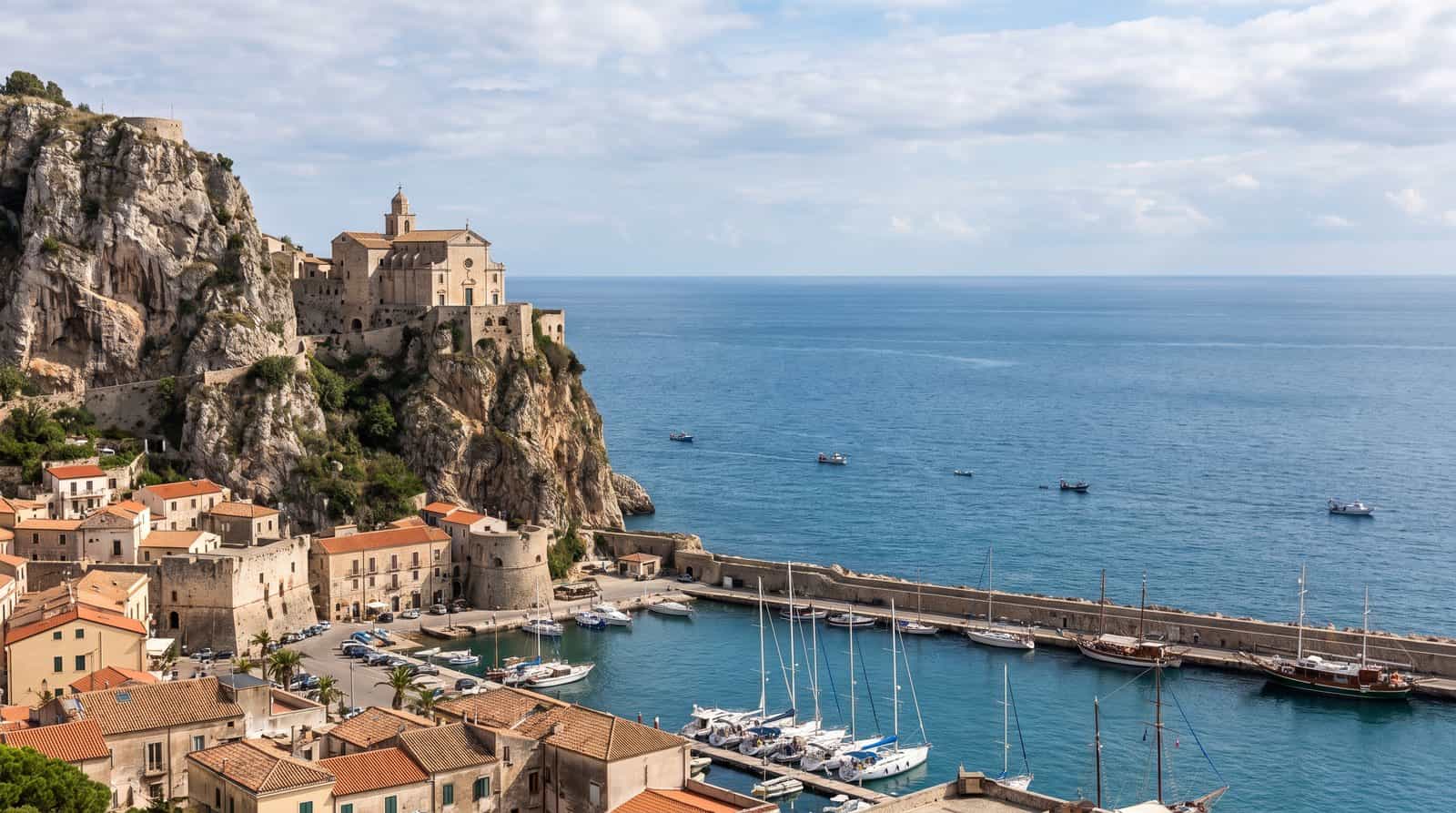
Gaeta occupies a promontory about 140 km south of Rome, at the point where Lazio stops being Roman and starts looking Neapolitan. For most of its history it belonged to the Kingdom of Naples, and it was the last place to fall when that kingdom ended: the siege of 1861 closed the story of the Bourbons of Naples. The old quarter still has the look of a fortified border town, because that is what it was.
The town divides into two halves that feel like different places. Sant'Erasmo, the medieval quarter, climbs the slope below the Angevin-Aragonese castle in a tangle of alleys and stairways. Porto Salvo, along the harbour, is the working town: ferries, fishing boats and the naval base that has been here since the nineteenth century.
The split mountain
The sight people come for is the Montagna Spaccata, a cleft that splits the rock of Monte Orlando from top to sea level, with a sanctuary built across the top of it. A staircase descends inside the fissure to a chapel wedged between the walls, and a second path leads to the Grotta del Turco, a sea cave at the bottom where the water comes in green. Local tradition ties the fissure to the moment of the Crucifixion; geology says it is a fault. It takes an hour, the steps are steep and wet, and the light is best in the morning.
Above it, Monte Orlando is a park with the Roman mausoleum of Lucius Munatius Plancus on the summit, a drum of stone from the first century BC with a view over the whole gulf.
The beaches
Serapo is the main one: a kilometre and a half of sand directly under the old town, with the rock of Monte Orlando closing it at one end. It is the reason Gaeta fills up in August, and it is also within walking distance of everything, which on this coast is rare. Further along the gulf, towards Sperlonga, lie the smaller coves of Sant'Agostino and Arenauta, quieter and harder to reach.
Getting there
Gaeta has no railway station. The nearest is Formia-Gaeta, about 10 km away, and Formia is also where the ferries and hydrofoils for Ponza and Ventotene leave. From the station it is a local bus or a taxi, and the buses connect with the trains reasonably well in summer.
By road it is around two hours and a half from central Rome, less from Ciampino. Most people who come here for a few days arrive by car, and it is one of the places where that makes sense: the coves outside town have no other way in.